
If you run a business and want to accept Lightning payments, you are probably not looking for a technical Bitcoin lecture. You want to know something much more practical:
- Can my customers pay me with Bitcoin?
- Can I receive the money safely?
- Does it work in my online shop, at the point of sale, or for invoices?
- And can I set it up without becoming a Bitcoin technician?
The short answer is yes.
Today, accepting Bitcoin Lightning payments is no longer just for crypto companies or technically advanced merchants. Online shops, restaurants, cafés, freelancers, hotels, agencies, service providers, and international businesses can all use Lightning payments in very practical ways.
I say this as someone who has worked with Bitcoin payment systems for years and as the CEO of Coinsnap, so yes, I may be biased. But I also see every day what merchants actually need: simple setup, direct payments, low fees, no chargebacks, and tools that fit into their existing business.
This article explains how businesses can accept Bitcoin Lightning payments in real life — online, in store, by invoice, and across borders.
Why Businesses Accept Lightning Payments
Businesses accept Lightning payments mainly because there is a growing group of Bitcoin owners who do not only want to hold Bitcoin — they also want to use it.
For merchants, that is a real business opportunity: Bitcoin users are often international, digitally active, financially independent, and open to trying new businesses that accept Bitcoin. If your business offers Bitcoin Lightning payments, you make it easier for these customers to buy from you, book with you, eat at your restaurant, pay your invoice, or support your service.
That does not mean every customer will suddenly pay with Bitcoin. But it does mean that your business becomes more attractive to customers who already own Bitcoin and are actively looking for places where they can spend it.
This is especially relevant for online shops, restaurants, hotels, freelancers, digital businesses, and international service providers. In these sectors, Bitcoin can be more than just another payment method. It can be a way to stand out, attract new customers, and show that your business understands modern payment behavior.
There are also practical business advantages.
Lightning payments are fast. A customer scans a QR code, confirms the payment in a wallet, and the payment is completed instantly.
Payments are final. There are no credit card chargebacks after the customer has paid.
Fees are low, which is especially useful for smaller transactions, point-of-sale payments, digital products, donations, subscriptions, and invoice payments. Low fees can also make business models viable that are difficult or impossible to run with the fee structure of credit card or PayPal payments — especially when margins are small or individual payments are very low.
And Lightning works internationally. A customer from another country can pay you without bank transfer delays, card restrictions, or expensive cross-border payment fees.
So the real reason to accept Lightning payments is not only technology. It is business development. You give Bitcoin customers a reason to choose your business — and you make it easy for them to pay you in the way they already prefer.
Where Businesses Use Lightning Payments Today
In practice, businesses do not accept Lightning payments in just one standard way. The right setup depends on how the business already sells, invoices, collects money, or interacts with customers.
The most common applications are ecommerce checkout, point-of-sale payments, invoices and billing, payment links, donations, crowdfunding, tips, and small-value digital payments.
For online shops, Lightning is usually added directly to the checkout. The customer selects Bitcoin as a payment method, scans a QR code, and the order is paid within seconds.
For physical businesses such as restaurants, cafés, retail shops, market stands, hotels, and events, Lightning is typically used through a Bitcoin Point of Sale. The merchant enters the amount, shows a QR code, and the customer pays on the spot.
For freelancers, agencies, consultants, and B2B service providers, Lightning often enters the business through invoices. The invoice contains a Bitcoin payment option, usually as a payment link or hosted payment page, so the customer can pay the exact amount with the correct reference.
Payment links are slightly different from invoice payments. An invoice is the business document that explains what is being charged. A payment link is the technical payment tool that lets the customer actually pay. In many cases, the two work together: the invoice contains the payment link.
Lightning is also very strong for donations, tips, creator support, and crowdfunding. In these cases, the payer is often not buying a standard product. They are supporting a project, creator, campaign, nonprofit, open-source tool, or community initiative. Lightning works well here because payments can be small, fast, and direct.
Another important application is digital content and micropayments. Low-value downloads, paid articles, paywalls, software tools, API access, and small digital services are often difficult to monetize with credit cards because the fees are too high. Lightning can make these small-payment business models more realistic.
International payments are not a separate payment method. They are a business situation where Lightning becomes especially useful. An international customer may pay through an online checkout, an invoice link, a donation button, or a payment page. The advantage is that the payment can happen without bank transfer delays, card restrictions, or expensive cross-border fees.
Accept Lightning Payments in an Online Store
For ecommerce businesses, the most natural place to accept Lightning payments is the checkout.
The customer fills the cart, goes to checkout, chooses Bitcoin or Bitcoin Lightning as the payment method, and receives a QR code. They scan the code with their Lightning wallet and confirm the payment.
After the payment is successful, the shop receives the payment confirmation and the order can be processed.
This is the classic use case for lightning payments for ecommerce.
It works especially well for:
- online shops selling physical products
- digital goods and downloads
- subscriptions and memberships
- tickets and events
- donations and support payments
- international ecommerce
For the merchant, the important point is that Bitcoin does not have to replace existing payment methods. You simply add it as one more option next to cards, PayPal, bank transfer, or local payment methods. With our modules and plugins, you can even offer customers a discount when they pay with Bitcoin — a simple way to motivate Bitcoin users to choose this payment method and give them an extra reason to buy from you.
That is usually what I recommend.
Do not redesign your entire checkout around Bitcoin. Add Bitcoin Lightning as an additional payment method, keep your normal checkout flow, and let customers choose it when it makes sense for them.
With Bitcoin payment software like Coinsnap, the technical integration is handled through a plugin, module, or API connection, depending on your shop system. Coinsnap does not act as a custodian or intermediary holding the merchant’s funds. The software facilitates the payment process and enables Bitcoin to move directly from the customer’s wallet to your company’s Bitcoin or Lightning wallet. For the customer, the experience remains simple: choose Bitcoin, scan the QR code, pay.
Accept Lightning Payments in Store with a Point of Sale
Lightning is also very useful for physical businesses that want to accept Bitcoin in store.
This includes:
- hotels
- restaurants, cafés, bars
- retail shops
- market stands
- food trucks
- service counters
- repair shops
- events and fairs
- cabs and ride-shares
In these situations, the process has to be very simple. Nobody wants to explain Bitcoin technology to a customer while there is a queue at the counter.
A good Bitcoin point-of-sale setup works like this:
The cashier enters the amount on a smartphone, tablet, or computer. The system creates a Lightning payment QR code. The customer scans the code and pays. The merchant sees the confirmation and hands over the product or service.
That is it.
This is where Lightning competes directly with the payment experience customers already know from smartphone wallets and card payments. A restaurant bill, a coffee, a sandwich, a taxi ride, or a retail purchase needs to be paid quickly and without friction. With Lightning, the customer scans a QR code, confirms the payment on their phone, and the merchant sees the payment confirmation within seconds. The experience feels familiar: phone out, scan, confirm, done.
For restaurants and cafés, Lightning can also be useful because it separates payments from card networks and chargeback risk. It can also be used for tips, event payments, or international guests who already use Bitcoin.
Again, I would not recommend making Bitcoin the only payment option. But as an additional modern payment method, it has proven its practical value time and again — especially in situations where customers already want to pay with Bitcoin and the merchant wants a fast, direct, and low-cost payment process.
Accept Lightning Payments for Invoices
Many businesses do not sell through a shopping cart or a physical checkout. They send invoices.
This is common for freelancers, consultants, agencies, B2B service providers, software companies, tradespeople, craftsmen, health providers, dentists, beauty clinics, cosmetic surgeons, therapists, plumbers, electricians, repair services, accountants, legal service providers, international service providers, small manufacturers, suppliers, and many other businesses that work with invoices instead of instant checkout payments.
For these businesses, there are two especially practical ways to accept Bitcoin Lightning payments: a Bitcoin Payment Link or a Bitcoin Invoice Form.
With a Bitcoin Payment Link, you create a specific payment request for a specific invoice. The payment link already contains the invoice amount, currency, description, and reference number. You then send this link to the customer by email, PDF invoice, messenger, or directly from your accounting or invoicing workflow.
The customer clicks the link, sees the payment page, scans the Lightning QR code, and pays. This is the easiest option if you want to prepare the payment request yourself and send the customer a ready-to-pay Bitcoin invoice link.
The second option is a Bitcoin Invoice Form. This works slightly differently. Here, the customer receives your normal invoice first — for example as a PDF, by email, or from your accounting system. On that invoice, you include a link to your Bitcoin payment page. With Coinsnap, this payment page can either be embedded on your own website or hosted by Coinsnap, depending on how you want to present the payment option to your customer.
The customer then enters the invoice amount and invoice reference into the form and pays by Bitcoin Lightning. This is useful if you issue invoices through an existing accounting system but still want to give customers an easy way to pay those invoices with Bitcoin.
So the difference is simple: with a Payment Link, the merchant creates a prepared payment request for the customer. With an Invoice Form, the customer uses the invoice information they already have and enters the payment details themselves.
Both methods fit naturally into invoice-based businesses. You do not need an online shop, a checkout system, or a complicated payment integration. You simply add Bitcoin as an additional payment option to the invoicing process you already use.
For international invoices, this can be especially attractive. Instead of waiting for a bank transfer from another country, the customer can pay directly with Bitcoin Lightning — quickly, with clear reference information, and without the friction of traditional cross-border payments.
International Customers and Cross-Border Payments
International payments are one of the strongest business cases for Bitcoin and Lightning.
Anyone who has dealt with cross-border payments knows the problems:
- Bank transfers can be slow
- Card payments can fail or be charged back
- International fees can be high
- Currency conversion can be unclear
- Some customers do not have easy access to the payment methods you normally offer
Bitcoin Lightning payments avoid many of these problems.
A customer in another country can pay you directly from their Bitcoin wallet. The payment does not depend on local card schemes, banking hours, or international transfer networks.
For online businesses, this can open the door to customers who may not be easy to serve with conventional payment methods.
For hotels, travel businesses, software providers, digital product sellers, agencies, and international freelancers, this is often one of the most practical reasons to accept bitcoin lightning payments.
This does not mean Lightning replaces your normal banking setup. But it gives you an additional global payment rail that works independently from traditional payment infrastructure.
Offer Lightning, but Enable On-Chain, Too
For most everyday payments, Lightning is the best customer experience: fast, simple, and ideal for smaller amounts. But for larger invoice amounts, it is useful to support on-chain Bitcoin payments as well. Solutions such as Coinsnap support both Lightning and on-chain Bitcoin payments, so larger transactions are covered too — for example payments above €1,000, where an on-chain Bitcoin transaction is often the more practical and reliable option.
Accounting Advantages of Bitcoin Payments for Business
Many merchants are interested in Bitcoin payments but worry about accounting.
That is understandable.
If you run a business, payments must be traceable. You need order references, invoice references, transaction history, export options, and clear records. A proper Bitcoin payment system should therefore not just show that “some Bitcoin arrived.” It should connect the payment to the business transaction.
For example, in an online shop, the Bitcoin payment should be linked to the order number.
For invoices, the payment should be linked to the invoice reference.
For point-of-sale payments, the transaction should show the amount, date, time, and payment status.
This is one reason why I strongly recommend merchants use a payment solution built for businesses rather than just showing a personal wallet QR code.
A personal wallet may be fine for a test payment. But for real business payments, you need transaction records, references, exports, and a clear payment flow.
With Coinsnap, merchants can see all their Bitcoin transactions in the dashboard and export transaction data for accounting and reconciliation. Each transaction is documented with the relevant invoice and deposit details, including invoice ID, date, order ID, order number, expected amount, paid amount, currency, payment method, payment status, receipt, deposit method, processed-at timestamp, deposit amount, network fee, Coinsnap fee, destination wallet or Lightning address, and deposit hash.
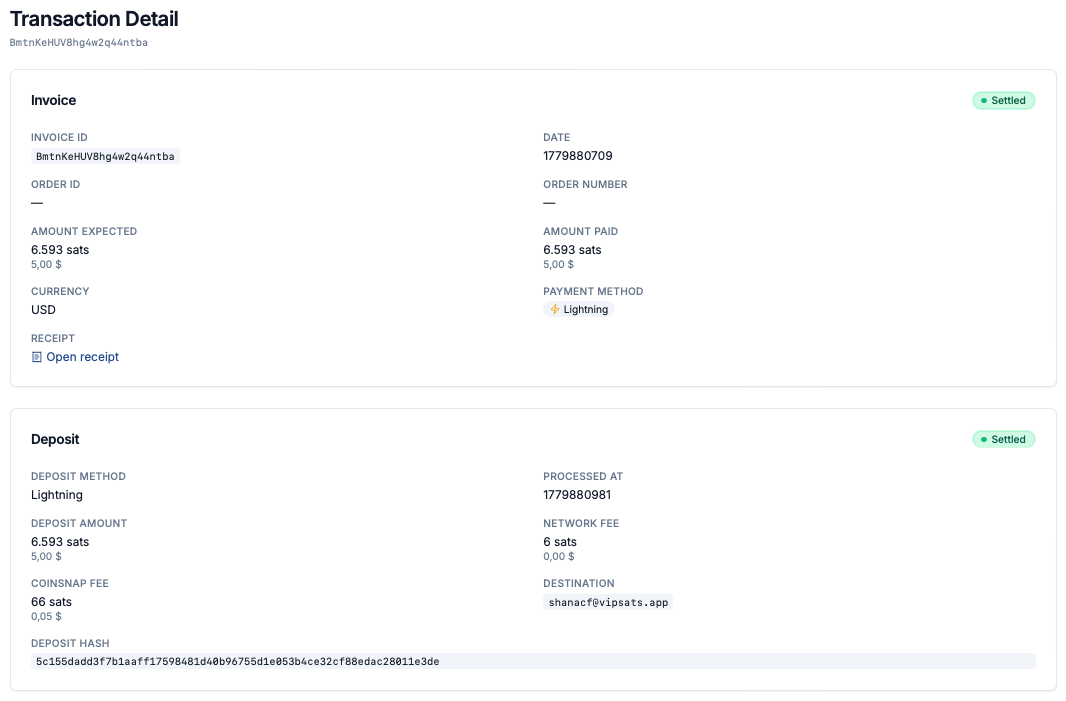
This allows merchants to clearly match each Bitcoin payment to the underlying business transaction — whether it comes from an online order, invoice, payment link, point-of-sale sale, donation, or crowdfunding campaign. Instead of dealing with anonymous wallet entries, they get structured payment records that can be reviewed, exported, and used for reconciliation.
How Coinsnap Works
Coinsnap provides Bitcoin payment modules, plugins, and tools for merchants who want to accept Bitcoin and Lightning payments directly from their customers’ wallets into their own Bitcoin or Lightning wallets.
The idea is simple:
- Your customer pays with Bitcoin.
- Coinsnap processes the payment.
- The payment is credited directly to your Bitcoin wallet, Lightning wallet, or — depending on your setup and partner options — converted into fiat currency and settled to your bank account.
The key point is that Coinsnap is designed for merchants, not just for private wallet users.
Coinsnap offers different types of Bitcoin payment software for different business situations. There are Coinsnap modules for popular shop systems, allowing merchants to add Bitcoin and Lightning payments directly to their online checkout. There are also Coinsnap add-ons for widely used WordPress plugins such as Contact Form 7, WPForms, Gravity Forms, Ninja Forms, GiveWP, Easy Digital Downloads, Paid Memberships Pro, and GetPaid.
In addition, Coinsnap provides its own native WordPress plugins, including Bitcoin Invoice, Bitcoin Donation, Bitcoin Crowdfunding, Bitcoin Voting, Bitcoin Shoutout, and Bitcoin Paywall. These are designed for website operators who want to accept Bitcoin payments, donations, contributions, or content payments directly through WordPress.
For businesses that do not use a specific shop system or WordPress plugin, Coinsnap also offers platform-independent Bitcoin tools such as Bitcoin Point of Sale, Payment Link, Payment Button, and HTML Bitcoin Invoice Form. These tools can be used on almost any website or in real-world payment situations, without being tied to a particular ecommerce framework.
That flexibility matters. A freelancer needs a different payment tool than a restaurant. A WooCommerce shop needs something different than a hotel reception. A B2B supplier sending invoices needs a different workflow than an ecommerce store.
The payment logic is always similar, but the business use case is different.
How to Accept Lightning Payments with Coinsnap
The setup is intentionally simple.
Step 1: Create Your Coinsnap Account
You start by creating a Coinsnap account with your email address.
After confirming your email, you can access the Coinsnap dashboard and create your store or payment setup.
Step 2: Connect Your Wallet
Next, you connect the wallet where you want to receive your Bitcoin payments.
This can be a Lightning wallet, a Bitcoin wallet, or a BTCPay Server setup, depending on how you want to operate.
For testing, a simple Lightning wallet can be enough. But for real business use, I recommend thinking carefully about custody, access, accounting, and long-term operations.
If you accept real customer payments, your wallet becomes part of your payment infrastructure. That deserves more attention than just downloading the first wallet app you find.
Step 3: Choose Your Payment Tool
Now choose how you want to accept payments.
- If you run an online shop, install the Coinsnap payment module for your shop system.
- If you send invoices, use a Bitcoin payment link or invoice payment tool.
- If you accept payments in person, use the Bitcoin Point of Sale.
- If you need a custom setup, use the Coinsnap API or connect via BTCPay Server.
The right tool depends on your business model.
Step 4: Add Bitcoin to Your Customer Payment Flow
Once the tool is connected, Bitcoin appears as a payment option for your customers. In an online shop, this happens at checkout. At the point of sale, the cashier creates a payment QR code. For invoices, you send a payment link.
The customer pays, and the payment is confirmed.
Step 5: Track and Export Transactions
After payments are received, you can track them in the Coinsnap dashboard.
For business use, this is important. You want to know which payment belongs to which order, invoice, or customer transaction.
You can then use the available transaction records and exports for accounting, reconciliation, and internal reporting.
Practical Use Cases
Online Shop
An online shop adds Bitcoin Lightning as an additional checkout option. A customer buys a product, selects Bitcoin at checkout, scans the QR code, and pays. The shop receives the payment confirmation and processes the order.
This is the most common ecommerce use case.
Restaurant or Café
A restaurant uses a Bitcoin Point of Sale on a tablet or smartphone. The waiter enters the bill amount, shows the QR code, and the guest pays with a Lightning wallet. The payment is confirmed within seconds.
This is useful for restaurants with international guests or Bitcoin-friendly customers.
Freelancer
A freelancer sends an invoice to an international client. The invoice includes a Bitcoin payment link. The client clicks the link and pays the invoice with Lightning.
The freelancer receives the payment without waiting for an international bank transfer.
B2B Service Provider
A small agency works with customers in different countries. Instead of relying only on bank transfers, it offers Bitcoin Lightning as an additional payment method for invoices.
Each payment is linked to the invoice reference, making reconciliation easier.
Retail Shop
A local retailer accepts Lightning payments in store. Customers can pay at the counter by scanning a QR code. The retailer receives instant confirmation and can track all payments later.
This gives the shop a modern additional payment option without buying expensive hardware.
Should Every Business Accept Lightning Payments?
Not every business needs to accept Lightning payments immediately. But many businesses can benefit from offering it as an additional option.
I would especially recommend looking at Lightning payments if your business has one or more of these situations:
- You sell online
- You work with international customers
- You send invoices
- You serve tourists or international guests
- You sell digital products
- You want to reduce chargeback risk
- You want lower payment fees
- You want to attract Bitcoin users
- You want a modern payment option without replacing your existing systems
The important point is not to force Bitcoin into your business. The better approach is to add it where it solves a real payment problem.
Conclusion: Accepting Lightning Payments Is Now a Practical Business Option
Accepting Lightning payments is no longer complicated, experimental, or limited to Bitcoin insiders. For many businesses, it is simply an additional payment method that can be used online, in store, for invoices, and for international customers.
The practical advantages are clear: fast payments, low fees, no chargebacks, global reach, and direct settlement. The business cases behind them are just as clear: attract Bitcoin-paying customers, reduce payment friction, support international sales, make small-value transactions more viable, and add a modern payment option without replacing your existing payment setup.
My recommendation is simple: With a solution like Coinsnap, you do not need to build your own Bitcoin payment infrastructure. Start with a plugin, a payment link, a point-of-sale tool, or an API integration — depending on how your business actually receives payments.
And do not think of Bitcoin Lightning as a replacement for all your existing payment methods. Think of it as a practical additional payment rail for customers who want to pay with Bitcoin — and for business situations where traditional payments are slow, expensive, or inconvenient. That is where Lightning becomes useful!
Get started – get your Lightning wallet now!
FAQs: Accept Lightning Payments
To accept Lightning payments means that your business can receive Bitcoin payments through the Lightning Network. Customers pay from a Lightning wallet, usually by scanning a QR code, and the payment is confirmed within seconds.
Yes. Online shops can accept Bitcoin Lightning payments by adding a payment plugin, module, or API integration to their checkout. Customers select Bitcoin as the payment method, scan a QR code, and complete the payment.
Yes. Physical businesses can accept Bitcoin in store with a Bitcoin Point of Sale. The cashier enters the amount, the system creates a QR code, and the customer pays with a Bitcoin or Lightning wallet.
Yes. Restaurants, cafés, bars, and food businesses can use Lightning payments for fast point-of-sale transactions. This is especially useful when serving international guests or Bitcoin-friendly customers.
Yes. Freelancers can accept Bitcoin Lightning payments by sending payment links with their invoices. The customer clicks the link, scans the QR code, and pays the invoice with Bitcoin.
Yes. Lightning payments are especially useful for international customers because they do not depend on bank transfer delays, card networks, or local payment systems. A customer can pay from almost anywhere with a compatible Bitcoin wallet.
No. With a merchant payment solution such as Coinsnap, you do not need to build your own Bitcoin infrastructure. You can use plugins, payment links, point-of-sale tools, or API integrations depending on your business.
Yes, if you want to receive Bitcoin directly. You need a wallet or a connected setup where your Bitcoin or Lightning payments are credited. Some merchants may also use fiat settlement options through supported partners.
Yes. Bitcoin and Lightning payments are final. This means there are no credit card-style chargebacks after the payment has been completed.
The operational risk depends on how you set it up. If you receive Bitcoin directly, you are exposed to Bitcoin price movements. If you use a fiat settlement option, that exposure can be reduced. From a payment perspective, Lightning payments are fast, low-cost, and final.
Coinsnap provides Bitcoin payment tools for merchants, including online shop integrations, payment links, invoice payment tools, point-of-sale solutions, WordPress plugins, and API options. This allows businesses to accept Bitcoin and Lightning payments without building their own payment infrastructure.
The easiest way depends on your business. Online shops should usually start with a shop plugin or payment module. Freelancers and invoice-based businesses can start with a payment link. Restaurants and physical stores can start with a Bitcoin Point of Sale.